For many people, the gym itself is not the problem. The problem is uncertainty. There is equipment everywhere, people moving with purpose, and very little indication of what a first session should look like. When a starting gym workout plan feels unclear, hesitation builds quickly.
A beginner gym workout does not need to be impressive to be effective. It needs to be repeatable. To see results, you need a gym plan for beginners that removes the guesswork and focuses on building a foundation of strength and confidence.
What A Beginner Routine Should Prioritize
At the early stage, progress comes from physical adaptation, not extreme intensity. Your first gym schedule for beginners should focus on establishing familiarity with movement, the gym space, and basic effort.
An effective beginner workout plan should focus on:
- Full-body training: Working the whole body each session rather than complex splits. This increases training frequency per muscle group and accelerates overall adaptation without overcomplicating the program.
- Simple movement patterns: Squats, hinges, pushes, and pulls repeated over time. These foundational patterns build strength, coordination, and body awareness that carry over into all future training.
- Moderate effort: Training hard enough to stimulate muscle, but light enough to allow for recovery. Staying around RPE 5–7 ensures you build capacity without excessive soreness or burnout.
This approach reduces confusion and lowers the "mental cost" of showing up consistently.
Why A Beginner’s Gym Plan Should Be Simple
Many beginners assume variety keeps motivation high. In practice, frequent changes create hesitation.
Simple routines help because:
- The order of exercises is familiar
- Less time is spent deciding what to do
- Progress is easier to recognize
Repeating similar movements across sessions builds confidence. Confidence, over time, reduces friction.
A Realistic Gym Schedule for Beginners
Most people do well training three times per week, with sessions lasting around 40–60 minutes. This frequency provides the right balance between stimulus and recovery, especially for beginners adapting to training. Allowing roughly 48 hours between sessions helps muscles recover, rebuild, and come back stronger without excessive fatigue.
A balanced session typically includes:
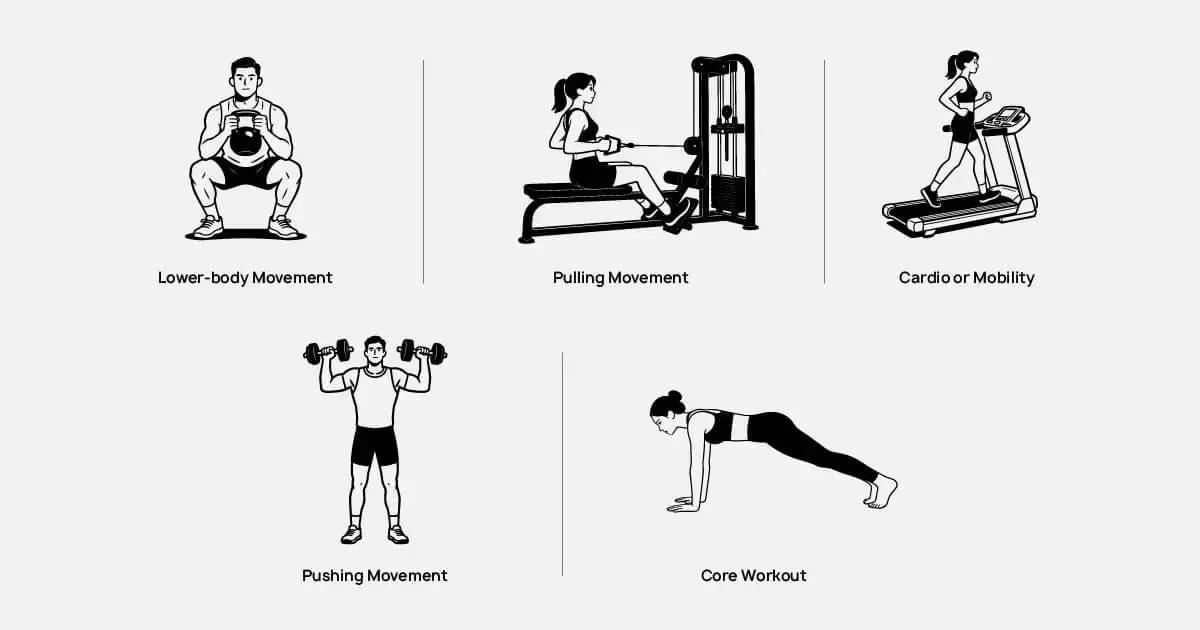
- One lower-body movement: Such as a goblet squat or leg press. This builds foundational strength in the legs and improves overall stability and movement efficiency.
- One pushing movement: Such as chest press or overhead press. Targets the chest, shoulders, and triceps, key muscles for upper-body strength.
- One pulling movement: Such as a seated row or lat pulldown. Balances the upper body by strengthening the back and improving posture.
- Light core work: For stability and posture. Focus on control-based exercises (planks, dead bugs) rather than high-fatigue movements.
- Light cardio or mobility work: It is important to add 5–10 minutes of light cardio or mobility work at the end of your session to support recovery and overall fitness.
This structure covers the body efficiently without overwhelming it.
How Hard the Sessions Should Feel
Your sessions do not need to be exhausting to be effective. In fact, effective training should feel challenging—but controlled and repeatable.
A useful benchmark for a starting gym workout plan is that effort should feel moderate, not maximal, where you can complete your sets with good form while still having 2–4 reps “in reserve”. This typically sits around RPE 5–7, where you’re working hard enough to stimulate progress without excessive fatigue.
Recovery should take days, not weeks. You should feel ready or close to ready for your next session within 24–48 hours. If soreness regularly interferes with your next scheduled session, the intensity of your beginner workout plan is likely too high for your current level.
When to Progress your Beginner Workout Plan
Early progress often appears quietly.
It shows up as:
- More stable movement: Better balance, coordination, and control through each exercise
- Better control of weights: Improved technique, smoother reps, and less reliance on momentum
- Reduced fatigue between sets: Faster recovery and the ability to maintain performance across sets
- Greater comfort in the gym environment: Less hesitation, more confidence, and smoother transitions between exercises
These are all early indicators that your nervous system and muscles are adapting effectively.
When To Adjust the Routine
Beginners do not need frequent changes.
Adjustments make sense when:
- Exercises feel consistently manageable
- Recovery is quick
- Sessions no longer require focus to complete
Small increases in weight or repetitions are sufficient. There is no need to redesign the routine entirely.
Where Gyms Fit into the Process
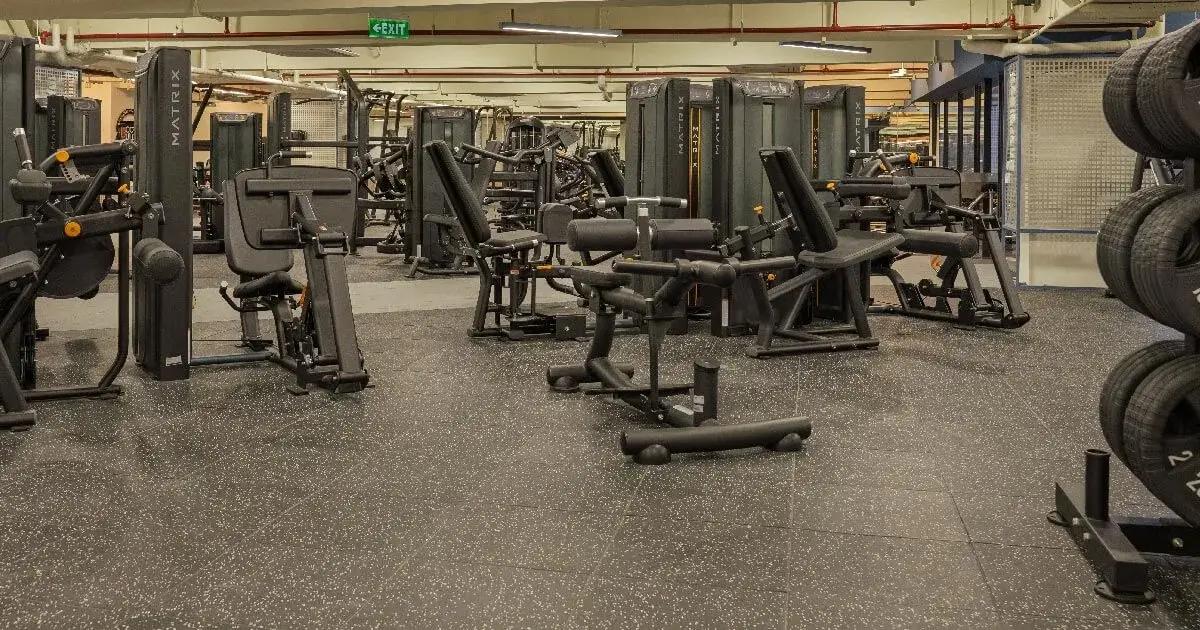
For beginners, gyms provide structure rather than motivation.
They offer:
- Equipment designed for controlled movement: Allowing beginners to learn proper technique safely and progressively
- Clear physical boundaries for training: Helping separate “training time” from daily distractions and improving focus
- Optional guidance when questions arise: Giving access to coaches or support when needed without pressure
Over time, the environment becomes familiar. The gym shifts from something intimidating to something functional.
If you’re unsure where to start, BeFit offers an environment where coaches can guide you, answer your questions, and support you as you build your routine.
A Practical Way Forward
A beginner routine works when it removes uncertainty and supports repetition. Consistency follows when sessions feel manageable and predictable.
Early training is not about pushing limits. It is about establishing a baseline that can be built on over time.
Frequently Asked Questions: Starting your Beginner Gym Routine
How long should a beginner workout last?
Around 40–60 minutes is sufficient for most people starting a beginner gym workout. This duration is long enough to be effective, but short enough to stay sustainable within a busy schedule.
A well-structured session typically includes:
- 5 to 10 minutes of warm-up (mobility or light cardio)
- 30 to 40 minutes of focused strength training or simple cardio work
- 5 to 10 minutes of cool-down or stretching
The focus should be on quality, not duration, doing the right exercises with proper form rather than extending the session unnecessarily.
Keeping sessions under an hour prevents overtraining and ensures you have the energy to maintain your gym schedule for beginners without feeling physically overwhelmed.
How often should beginners train?
Three times per week is the ideal frequency to build consistency and see physical progress. This provides enough training stimulus to improve strength, fitness, and energy levels without overwhelming recovery capacity.
Spacing sessions with at least one rest day in between (ex: Monday–Wednesday–Friday) allows muscles to recover, adapt, and come back stronger. Recovery is not a break from progress, it’s where progress actually happens.
Training just three times a week consistently is far more effective than trying to train five days a week and quitting after a month due to fatigue. Consistency over time will always outperform short bursts of high motivation.
As your fitness and recovery improve, you can gradually increase frequency to 4 sessions per week without disrupting your routine.
Is it necessary to change exercises often?
No, repetition is actually your best friend when following a gym plan for beginners. Frequent changes early on can slow progress by limiting your ability to learn and improve key movements. Repeating the same movements across multiple sessions helps your nervous system to develop coordination, efficiency, and proper technique.
Consistency in exercises allows you to build strength faster because your body becomes more efficient at performing those movements.
Sticking to a consistent beginner workout plan for 4–6 weeks provides a clear window for adaptation and measurable progress. It also makes tracking progress much easier, you can clearly see improvements in weight lifted, reps performed, or overall control from week to week.
Once progress slows or technique is well established, small variations can be introduced—but only after a solid foundation is built.
When should weights be increased?
You should consider increasing your weights or resistance when your current movements feel stable and smooth across every set of your beginner gym workout. This means your technique is consistent, controlled, and repeatable not just on the first set, but throughout the session.
A good rule of thumb: if you can complete all your repetitions with perfect form and still feel like you had 2–3 reps “in reserve” (RIR), it’s time for a small increase.
Progression should be gradual, typically increasing the load by 2.5–5% rather than making large jumps.
Alternatively, you can first increase reps within the same weight before increasing the load.
Always prioritize manageable recovery; if you are too sore to follow your regular gym schedule for beginners, you may have increased the weight too quickly.