Hyrox is a standardized global fitness race combining endurance running and functional fitness. Every official event follows the exact same format: 8 × 1-kilometer runs, each followed by one of 8 functional workout stations.
Because the course never changes, performance comes down to pacing, aerobic capacity, and recovery under fatigue. Following a structured 8–12 week Hyrox training plan combining running, functional strength, and race-pace intervals is the most effective way to prepare.
What Are the Physiological Demands of Hyrox Racing?
Although Hyrox features eight functional workout stations, running accounts for roughly 50% of total race time. Average finish times sit around 1:32 for men and 1:38 for women.
The core challenge isn't the individual stations—it's compromised running (maintaining pace immediately after heavy station work while legs are full of lactate).
Key Athletic Demands
- Aerobic Base: Essential for sustained 8km running performance.
- Muscular Stamina: For high-volume pushes, pulls, lunges, and throws.
- Pacing Efficiency: Preventing early burnout across a ~90-minute event.
- Grip & Core Stability: Heavy loading during carries, sled pulls, and lunges.
Hyrox vs. CrossFit: Unlike CrossFit, Hyrox excludes complex Olympic lifting and gymnastics. It relies on accessible, standardized equipment (rowers, SkiErgs, sleds, kettlebells, sandbags, wall balls), prioritizing pure work capacity over technical skill.
What Are the 8 Stations of the Hyrox Workout?
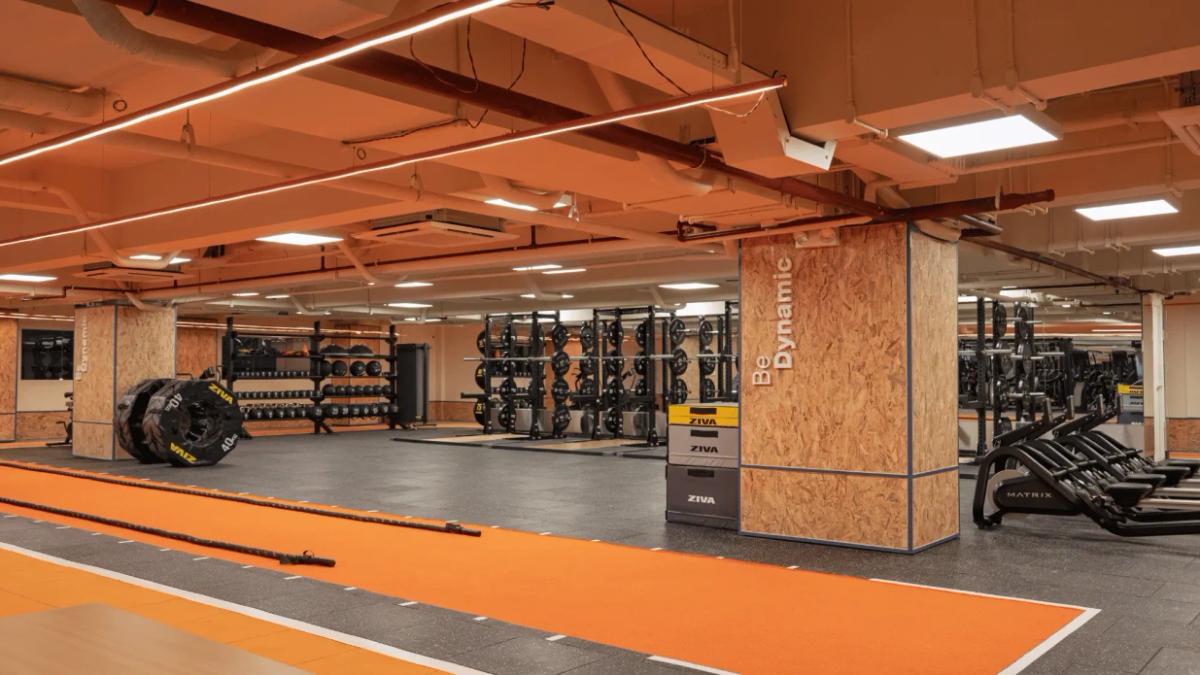
Every official Hyrox competition follows the exact same sequence of workout stations, making preparation highly specific and measurable. Unlike many other fitness races, the standardized format means athletes can accurately track progress and compare performances across different events worldwide.
Each station challenges a different aspect of fitness, from cardiovascular endurance and lower-body power to grip strength, core stability, muscular endurance, and mental resilience. Mastering the technique, pacing, and transitions at each station not only conserves energy but also prevents early fatigue and can shave valuable minutes off your overall finish time.
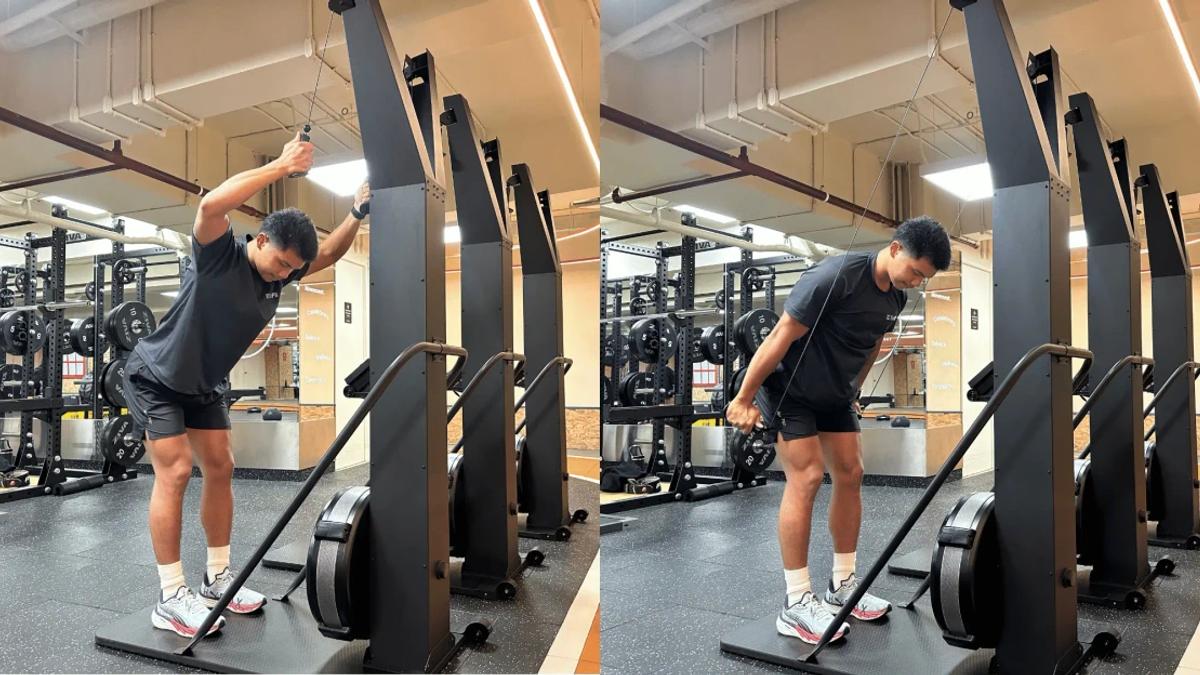
1. SkiErg (1000m): Tests upper-body pulling power and core endurance.
The SkiErg is the opening station of every Hyrox workout, making it tempting to start too aggressively. Maintaining a controlled pace allows you to preserve energy for the seven stations and eight runs that follow. Allow your arms to return overhead under control before beginning the next stroke.
How to Do the SkiErg
Stand with your feet hip-width apart and reach high for the handles. Initiate each pull by aggressively hinging at your hips and throwing your body weight downward, pulling the handles down in an arc past your thighs to full arm extension.
You know your form is correct when:
Your pulling power is generated entirely by your lats and core, rather than relying solely on your shoulders and arms.
Your lower back remains perfectly flat and braced as you hinge at your hips.
Your stroke rhythm is smooth and consistent without rushing the recovery phase.
Your 500-meter split pace stays highly consistent from the first stroke to the last pull.
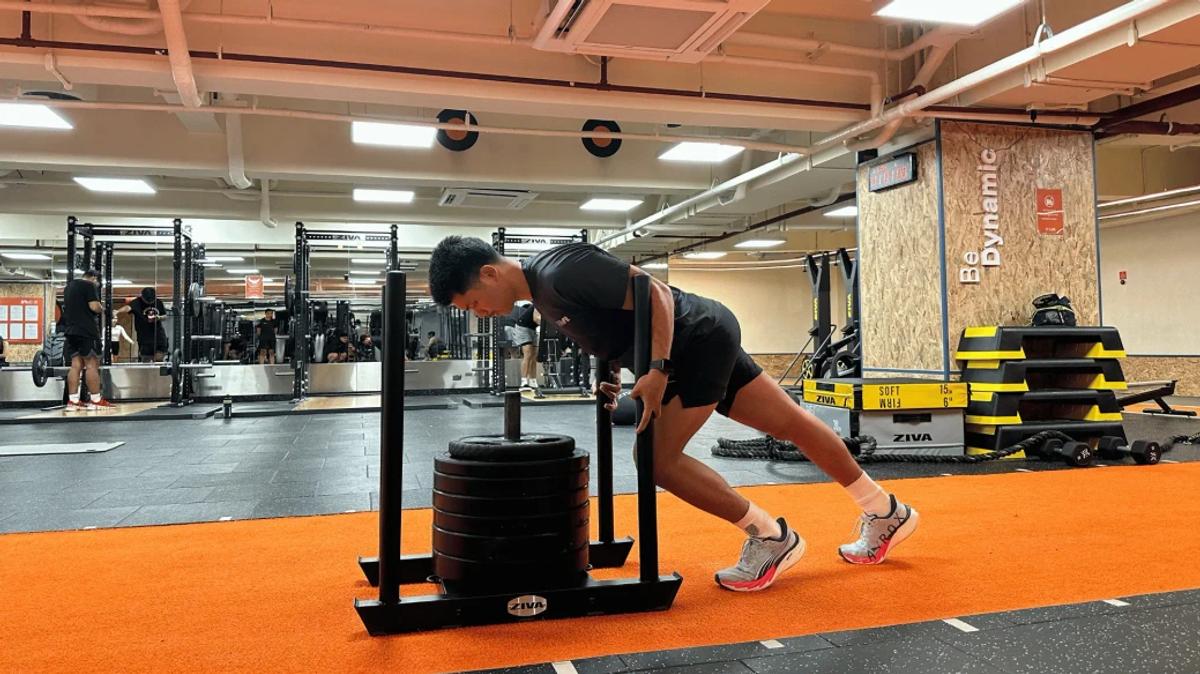
2. Sled Push (50m): A pure test of lower-body power and leg drive.
The sled push is one of the most physically demanding stations in Hyrox racing, placing significant stress on the quadriceps, glutes, calves, and cardiovascular system.
How to Do the Sled Push
Drop your hips low, lean forward at a 45-degree angle, and place your hands flat at shoulder height on the poles. Drive the sled forward using short, explosive piston-like steps, keeping your arms locked straight to transfer leg power directly into the machine.
You know your form is correct when:
- Your arms remain fully locked straight with your torso holding a strong 45-degree forward lean.
- Your feet drive the sled forward using rapid, short steps pushing off the balls of your feet.
- Your quads and glutes absorb the entirety of the work rather than straining your lower back.
- You maintain a steady pace without stopping between lengths.

3. Sled Pull (50m): Targets the posterior chain and grip strength.
The sled pull develops pulling strength, grip endurance, and total-body coordination while challenging your ability to recover after the sled push.
How to Do the Sled Pull
Face the sled, grip the rope with both hands, and lean back to let your body weight do the heavy lifting. Walk backward with small, controlled steps, pulling the rope hand-over-hand while keeping your core tightly braced.
You know your form is correct when:
- Your body weight is leaned backward to assist the pull rather than relying strictly on your arm muscles.
- Your steps are steady and continuous, keeping your elbows tight to your ribs as you pull the rope hand-over-hand.
- Your grip remains secure on the raw-grip rope without slipping down to your fingertips.

4. Burpee Broad Jumps (80m): A high-intensity movement that spikes the heart rate.
Burpee broad jumps combine explosive power with cardiovascular endurance and often become one of the toughest stations late in the race.
How to Do Burpee Broad Jumps
Drop your hands, jump your feet back to a plank, and lower your chest flat to the floor. Push up explosively, snap your feet back under your hips, and leap forward as far as possible, landing softly on both feet to transition directly into the next rep.
You know your form is correct when:
- Your chest makes clear and full contact with the floor on every single repetition.
- Your landing is balanced and soft on both feet together, preparing your body to transition instantly into the next burpee.
- Your movement follows a steady, unbroken rhythm without needing to stop and recover your breath.
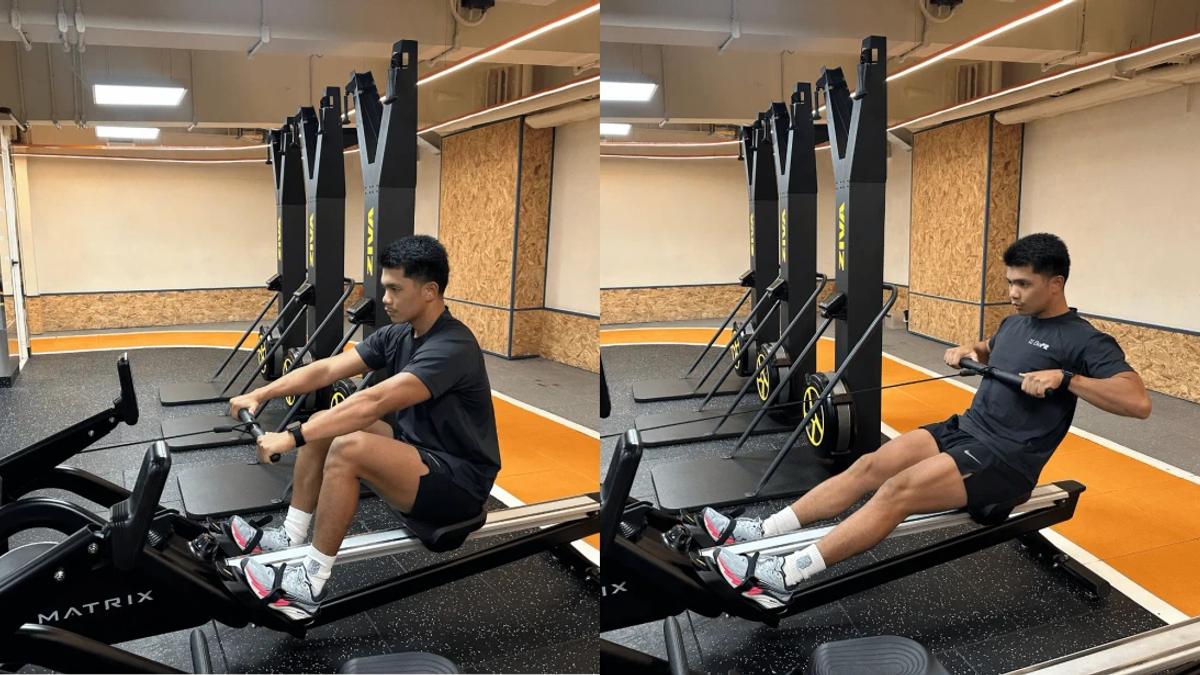
5. Rowing (1000m): A mid-race test of aerobic efficiency and pacing.
The rowing station rewards efficient technique rather than brute strength. Athletes who pace correctly often gain valuable time while conserving energy for the remaining stations.
How to Do the Rowing Machine
Strap in and drive aggressively through your legs first, lean your torso back slightly to a 30-degree angle, and pull the handle to your lower chest. Keep your damper at a moderate setting (4 to 5) to favor a quick, efficient stroke rate of 24 to 28 strokes per minute.
You know your form is correct when:
- Your stroke sequence flows naturally by driving with your legs first, hinging your hips, and then pulling the handle to your chest.
- Your rowing chain travels in a perfectly horizontal line throughout the entire drive and recovery.
- Your 500-meter split pace remains locked onto your target split with minimal variance.
- Your recovery is controlled rather than rushed.

6. Farmers Carry (200m): Tests grip endurance and postural control under fatigue.
The Farmers Carry challenges grip strength, shoulder stability, core endurance, and posture while your heart rate remains elevated.
How to Do the Farmers Carry
Hinge at your hips to pick up the kettlebells. Stand tall with your shoulders pulled back and down, brace your core, and walk with quick, short, focused steps.
You know your form is correct when:
- Your posture stays perfectly tall and upright with your shoulders pinned back and your core braced.
- Your hands stay clamped tightly onto the center of the kettlebell handles without slipping.
- Your transitions and turns are controlled, using a safe hip hinge to lift or lower the weights.
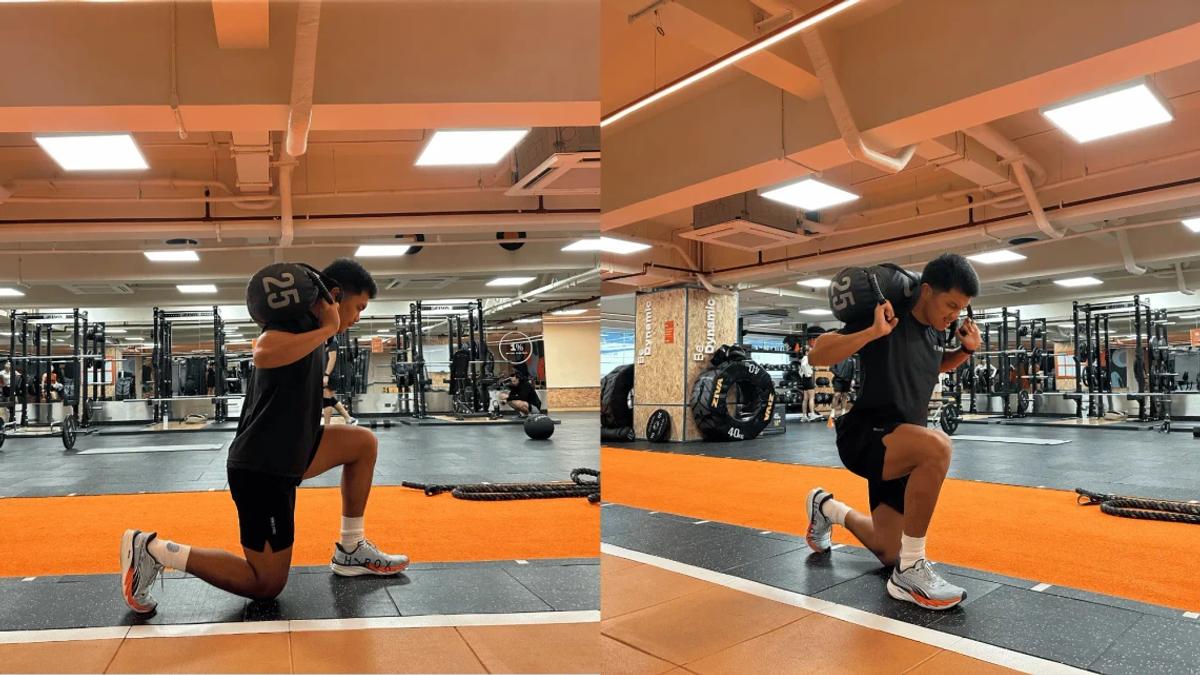
7. Sandbag Lunges (100m): A taxing unilateral leg strength station.
Sandbag lunges demand leg strength, balance, coordination, and mental resilience while placing continuous tension on the lower body.
How to Do Sandbag Lunges
Clean the sandbag onto your shoulders or in a comfortable bear-hug hold. Step forward, lowering your back knee until it gently touches the floor, then drive through your front heel to step directly into the next lunge.
You know your form is correct when:
- Your trailing knee gently kisses the floor on every single lunge step.
- Your lead knee tracks in a straight line over your toes without collapsing inward.
- Your torso stays upright and stable, successfully resisting the forward pull of the sandbag.
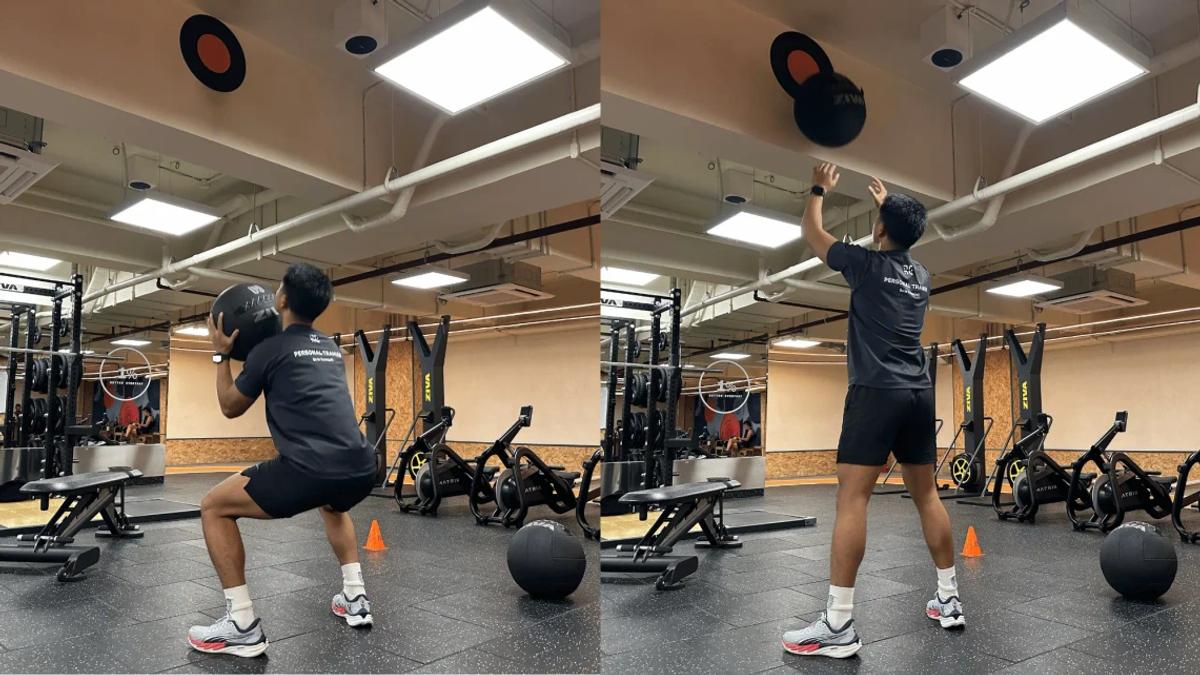
8. Wall Balls (100 reps): The final test of explosive power and mental toughness.
Wall balls finish every Hyrox workout by combining squatting, pressing, coordination, endurance, and mental determination under extreme fatigue.
How to Do Wall Balls
Stand arms-length from the target wall, holding the medicine ball at chest height. Drop into a deep squat (hips below parallel), then drive upward explosively to throw the ball to the target line. Catch the ball and sink directly back into the next squat.
You know your form is correct when:
- Your hips drop below parallel on every single squat to avoid any "no-rep" calls.
- Your throws clearly hit or cross the target line with every repetition.
- You maintain a smooth catch-and-throw rhythm.
- Your high-volume sets are broken into structured, manageable chunks with short, disciplined rest periods.
How Do You Build a Sustainable Hyrox Training Plan?
A sustainable Hyrox plan balances running volume, muscular endurance, and race simulation. Since the race combines continuous running with high-volume stations, weekly training must target three core pillars:
1. Aerobic Engine (2x / week)
Running makes up ~50% of race time. Build your engine with two distinct sessions:
- Zone 2 Base Run (45–60 min): Conversational pace to increase aerobic capacity and speed up recovery between stations.
- Race-Pace Intervals: 4–6 × 1 km repeats at target race pace (with controlled recovery) to build pacing discipline under fatigue.
2. Strength Endurance (1–2x / week)
Hyrox requires high-volume power output, not 1-rep maxes.
- Focus: Swap heavy, low-rep lifting for moderate-load, high-volume work (3–4 sets of 15–20 reps).
- Key Exercises: Front squats, lunges, step-ups, sled drives, kettlebell carries, and wall balls.
3. Compromised Training (1x / week)
The defining challenge of Hyrox is running immediately after heavy station work (compromised running).
- Execution: Alternate 1 km runs at race pace with functional stations (e.g., 1 km run → 20 burpee broad jumps → 1 km run → 200m farmers carry).
- Goal: Teaches your body to maintain running economy and smooth transitions when your legs are filled with lactate.
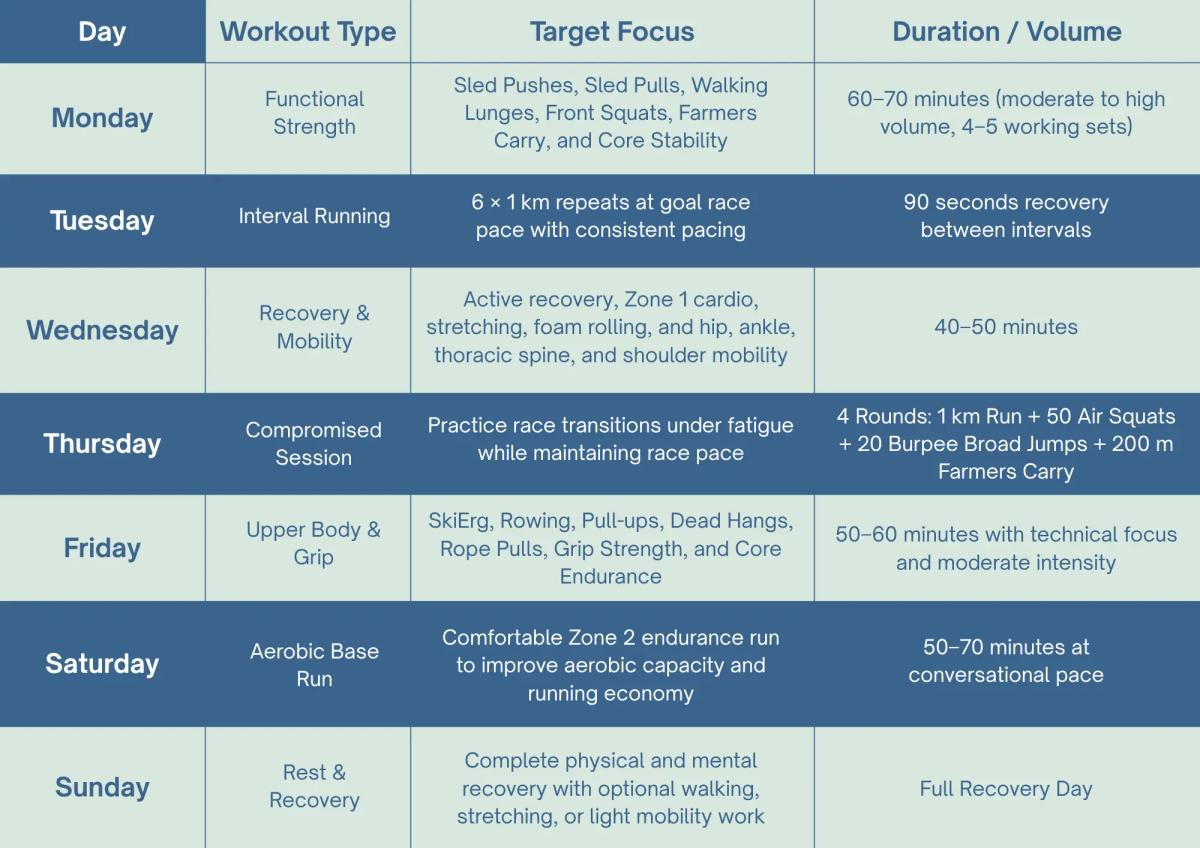
What Does a Sample Weekly Hyrox Training Plan Look Like?
A structured Hyrox training plan helps you develop the endurance, strength, and movement efficiency needed to perform well on race day without accumulating excessive fatigue. The schedule below is designed for an 8-week training block and provides a balanced combination of running, functional strength, recovery, and race-specific conditioning.
As your fitness improves, you can gradually increase running pace, training volume, or workout intensity while maintaining at least one full recovery day each week. Consistency is more important than performing every session at maximum effort, as steady progression produces the best long-term results.
How Do You Adapt Hyrox Training for a Commercial Gym?
One of the biggest advantages of Hyrox training is that most of its movement patterns can be replicated in a standard commercial gym without requiring specialized race equipment. By matching the same movement mechanics, muscle demands, and training intensity, you can build the strength, endurance, and work capacity needed to prepare for a Hyrox competition.
The most effective way to prepare is by training at an official HYROX partner gym like BeFit, which offers specialized HYROX prep classes and 1-on-1 coaching with a certified personal trainer. This gives you hands-on access to official race equipment, structured programming, and expert guidance designed to replicate exact competition conditions.
However, if your gym doesn't have HYROX-specific equipment, you can still follow an effective Hyrox training plan using common machines and free weights. The goal is to recreate the same movement patterns, loading profiles, and cardiovascular demands rather than the exact equipment, these simple exercise swaps work perfectly:
SkiErg (1,000m) Swap
- Setup: Dual high-cable pulley with a triceps rope or handles.
- Execution: Perform explosive straight-arm pulldowns with a strong hip hinge. Drive power through your lats and core in a smooth, continuous rhythm.
Sled Pull (50m) Swap
- Setup: Low-cable pulley attached to a thick rope.
- Execution: Lean back slightly with a braced core and walk backward, pulling the rope hand-over-hand to build grip and posterior chain endurance under fatigue.
Sandbag Lunges (100m) Swap
- Setup: Barbell (back-rack or front-rack) or heavy dumbbells/kettlebells (suitcase or goblet hold).
- Execution: Perform walking lunges with an upright posture, ensuring your trailing knee gently touches the floor on every rep.
Frequently Asked Questions About Hyrox
How do I improve my Hyrox racing time?
To lower your Hyrox finish time, prioritize running efficiency and Roxzone transition speed. Running accounts for ~50% of the total 90-minute average race time, meaning a 10-second reduction per kilometer saves 80 seconds across the 8 km course.
- Build Zone 2 Aerobic Capacity: Dedicate 1–2 weekly runs (45–60 minutes) at a conversational pace to lower your average heart rate and speed up recovery between stations.
- Train Compromised Running: Practice running immediately after high-fatigue movements (sled pushes, wall balls) to train your body to clear lactate without losing your natural running rhythm.
- Eliminate Roxzone Transit Time: Rehearse fast, purposeful transitions through the Roxzone between the track and station entrances to save 2 to 3 minutes of idle time.
- Maintain Race-Pace Pacing Discipline: Cap early effort on runs 1 through 3 at target race pace to prevent premature glycogen depletion and late-race fatigue on lunges and wall balls.
What is the difference between CrossFit and Hyrox?
The primary difference between Hyrox and CrossFit is predictability, movement technicality, and race structure. Hyrox is a standardized endurance race with an identical 8 × 1km run and 8-station format worldwide, whereas CrossFit relies on constantly varied, unpredictable workouts (WODs).
- Hyrox rewards: Pacing, running efficiency, fatigue resistance, and predictable race-specific endurance.
- CrossFit rewards: Broad athleticism, high technical skill, maximum strength, and adaptability to unpredictable workouts.
Both are excellent forms of functional fitness, but if your goal is to excel in a Hyrox competition, following a dedicated Hyrox program that closely mirrors the demands of race day is the most effective way to prepare.
Can I follow a Hyrox program if I am not an athlete?
Yes, Hyrox is built for all fitness levels, not just elite athletes. The competition offers scalable divisions—Open, Pro, Doubles, and Relay—allowing recreational participants to race with weights and formats matched to their experience.
- Recreational-Friendly Open Division: Features lighter station weights (e.g., 12 kg/16 kg kettlebells for Farmers Carry vs. Pro 24 kg/32 kg) while keeping the standardized 8 × 1 km format.
- Realistic Training Timeline: If you currently exercise 3 to 4 days per week, an 8-to-12-week Hyrox training plan provides sufficient aerobic capacity, functional strength, and confidence to complete your first race.
- Team Entry Options: Doubles (share station reps, run together) and 4-person Relays (2 runs + 2 stations per person) offer accessible, lower-volume entry points.
- Self-Paced Progression: Hyrox allows you to race against your own personal best, providing a clear, measurable path from your first finish line to prospective Pro divisions over time.