What Does PR Mean in the Gym? A Guide to Personal Records
If you've ever heard someone celebrate a new PR after a workout, you may have wondered what it means. PR stands for Personal Record, which is the best performance you have ever achieved in a specific exercise, movement, or workout. Whether you're lifting heavier weights, completing more repetitions, or running a faster time, a PR is one of the clearest indicators that your fitness is improving.
Understanding the PR meaning gym is one of the first steps toward training with purpose rather than simply exercising without measurable goals. Instead of relying on how you feel or how you look in the mirror, tracking your progress with personal records provides objective evidence that your body is becoming stronger, fitter, or more efficient over time.
For beginners and experienced lifters alike, setting and achieving a personal record adds motivation, builds confidence, and helps guide future training decisions. Every new PR, no matter how small, represents meaningful progress on your fitness journey.
What Is the Definition of a PR, and how can I track my PR in the Gym?
PR stands for Personal Record. The pr meaning in gym refers to the best performance you have ever achieved in a specific exercise or physical activity. While many people associate a PR with lifting the heaviest weight possible for one repetition, there are several different ways to set a personal record, depending on your training goals.
The most effective way to track your personal record is by keeping a dedicated workout log or PR tracker. Recording your exercises, weights, repetitions, workout volume, and performance times allows you to measure progress objectively rather than relying on memory. Whether you use a notebook, spreadsheet, fitness app, or a printable PR Tracker Template, consistently logging your results makes it easier to apply progressive overload, identify performance trends, and stay motivated throughout your fitness journey.
A complete PR tracker should record several types of personal records, not just your one-repetition maximum. Here are the four most common PR categories you should monitor:
1. Weight PR:
A Weight PR is achieved when you successfully lift more weight than ever before for a single repetition of a particular exercise.
Example: Increasing your back squat one-repetition maximum from 100 kg to 105 kg.
Recommended Tracker
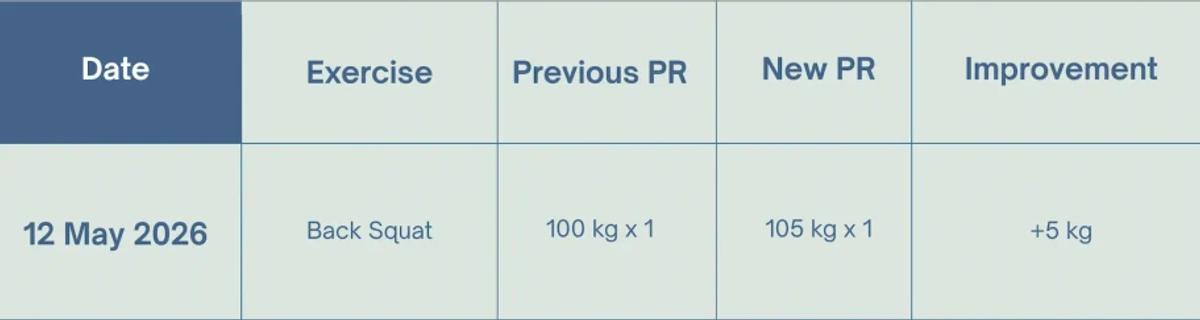
This is the type of PR most commonly celebrated by strength athletes and powerlifters because it directly reflects improvements in maximal strength.
2. Repetition PR:
A Repetition PR occurs when you complete more repetitions using the same weight than you previously managed.
Example: Performing 10 repetitions at 60 kg on the bench press when your previous best was 8 repetitions.
Recommended Tracker
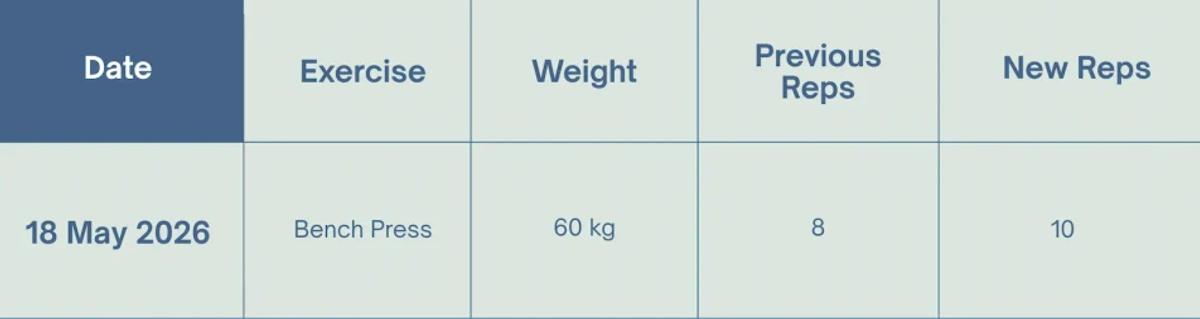
This type of PR demonstrates improvements in muscular endurance and work capacity while using a consistent training load.
3. Volume PR:
A Volume PR measures the total amount of work completed during a workout using the following formula:
Sets × Repetitions × Weight = Total Training Volume
Example: Completing 5 sets × 8 reps × 80 kg = 3,200 kg, compared with a previous session of 4 sets × 8 reps × 80 kg = 2,560 kg.
Recommended Tracker
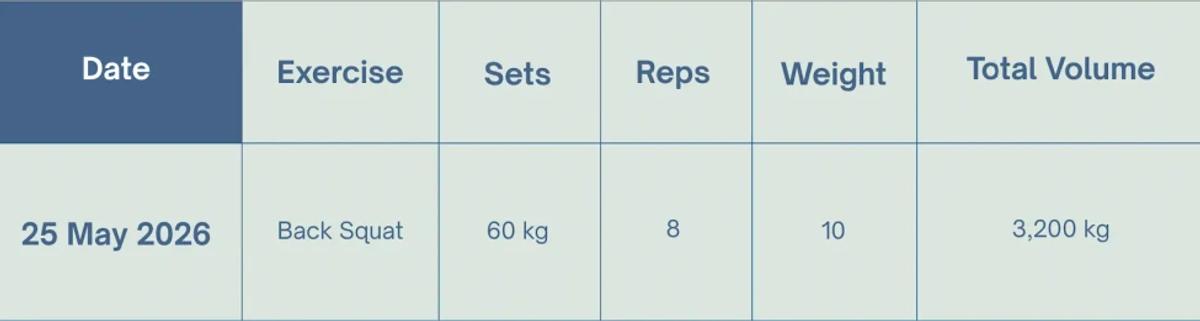
Tracking training volume helps athletes progressively increase workload over time while managing recovery and avoiding unnecessary plateaus.
4. Time PR:
A Time PR is achieved by completing a workout, circuit, or distance faster than your previous best.
Example: Finishing a 5 km run in 24:00 instead of 25:30.
Recommended Tracker
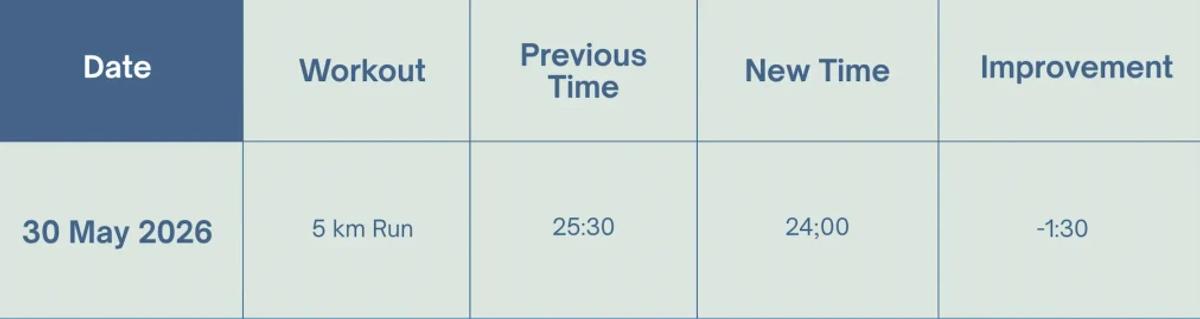
Time-based PRs are widely used in running, HYROX, rowing, cycling, functional fitness, and conditioning workouts where speed, endurance, and efficiency are important performance indicators.
Why Is Tracking Your PR Essential for Progressive Overload?
Tracking a personal record is one of the most effective ways to apply progressive overload, the scientific principle of gradually increasing the demands placed on your body to stimulate continued improvements in strength, muscle growth, endurance, and athletic performance.
Without recording your progress, selecting the right training weight often becomes guesswork rather than a structured progression. Knowing your previous best allows you to make small, measurable improvements over time instead of increasing weight too quickly or repeating the same workout indefinitely.
Tracking your PRs also provides valuable motivation. Physical changes in the mirror often take weeks or months to become noticeable, but your training log may already show measurable improvements in strength, repetitions, or workout performance. Seeing these small victories reinforces consistency and demonstrates that your training is producing results, even before major visual changes occur.
In addition, maintaining a PR log helps coaches and personal trainers make informed programming decisions by identifying strengths, weaknesses, and appropriate progressions for future workouts.
Practical Steps for Hitting a New PR
Achieving a new personal record is rarely the result of one exceptional workout. Instead, it comes from weeks or months of consistent training, proper recovery, and smart programming. The following strategies help maximize your chances of safely hitting PR in gym sessions.
1. Build a Foundation First
Before focusing on hitting a pr in gym sessions, the mechanics of the movement must be technically proficient at sub-maximal loads. A personal record only counts as genuine progress if the form used to achieve it matches the technical standard used in previous attempts. Increasing the load by sacrificing range of motion or joint alignment does not represent a true strength gain and significantly raises the risk of injury.
2. Follow a Consistent Program
A new personal record is the product of consistent training rather than a single lucky day in the gym.
Most effective strength programs spend the majority of training time using approximately 70–85% of your current one-repetition maximum, gradually increasing workload over several weeks before testing a heavier lift. This progressive approach develops muscular strength, movement efficiency, and nervous system adaptations that prepare your body for maximal efforts.
By the time PR day arrives, your body has already practiced producing force safely and efficiently under progressively heavier loads.
3. Use Professional Resources
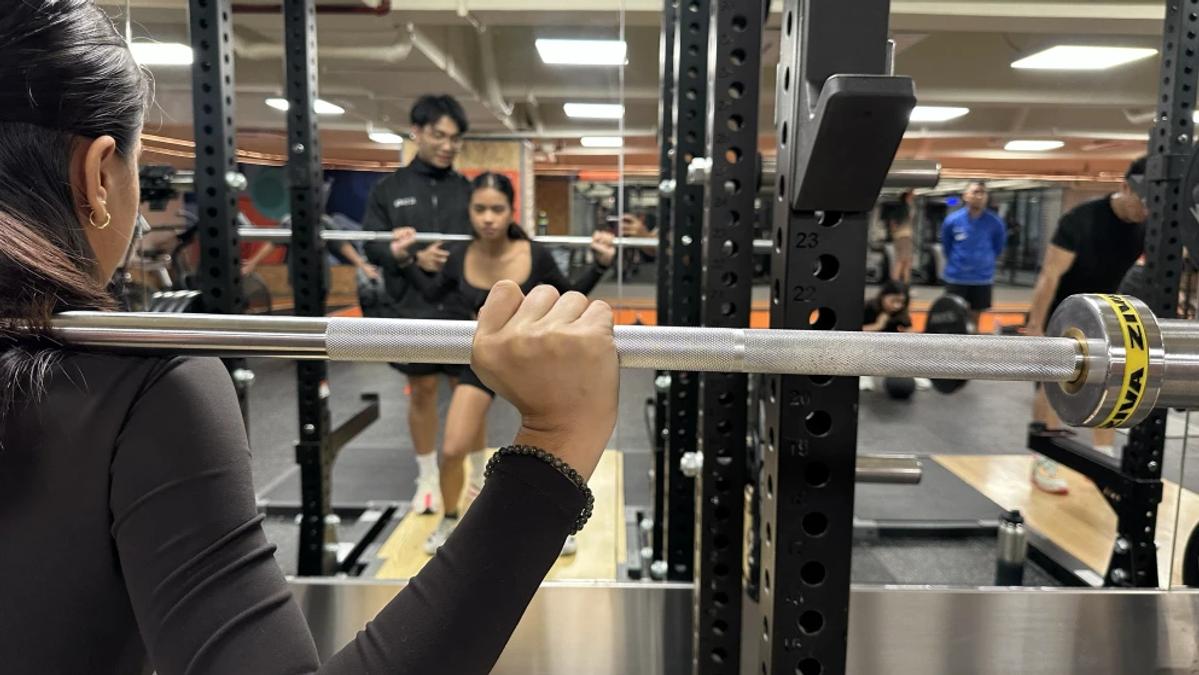
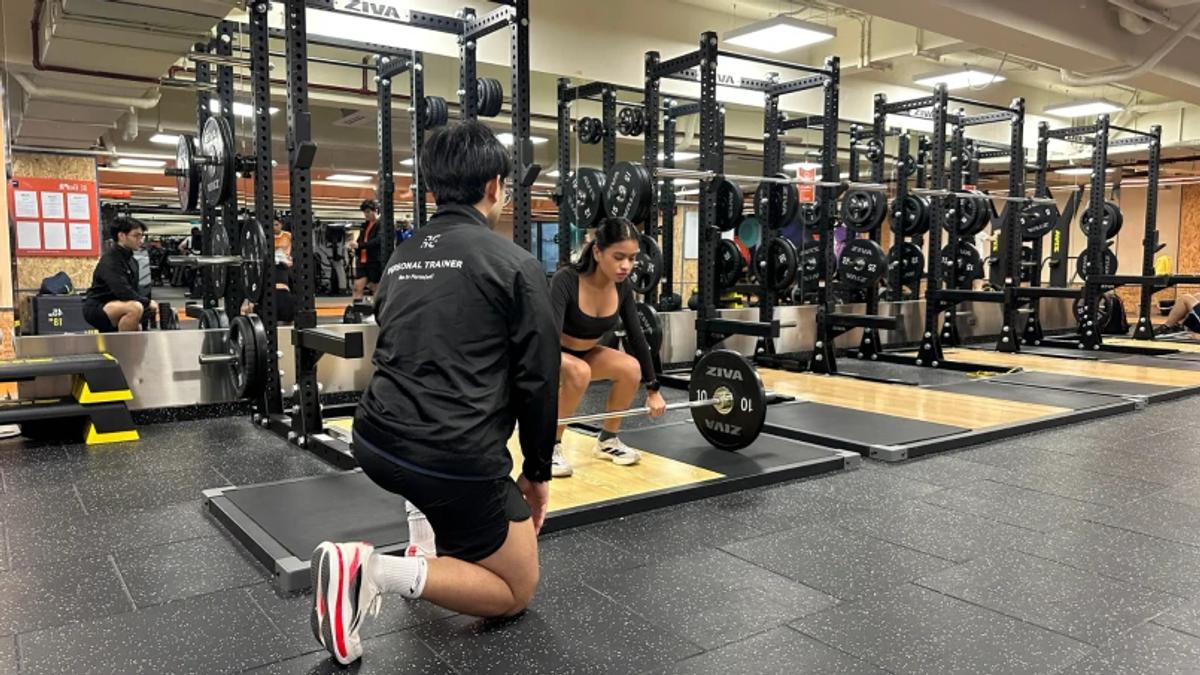
Testing a personal record is safer in a controlled, professional environment. At BeFit Gym, our certified personal trainers provide hands-on, one-on-one form correction during your PR attempts, while our structured fitness classes build the underlying strength and conditioning base required before testing a heavy lift. A professional training environment reduces the specific risks associated with attempting a maximal lift without supervision, including incorrect bar setup, missing safety equipment, and the absence of a spotter.
4. Prioritize Recovery and Nutrition
Strength gains occur during recovery—not during the workout itself.
To maximize your chances of setting a new personal record, consume approximately 1.6–2.2 grams of protein per kilogram of body weight each day, maintain a balanced diet, stay hydrated, and aim for 7–9 hours of quality sleep every night.
In the 48–72 hours before a planned PR attempt, many athletes reduce overall training volume by 30–50% through a short deload period. This allows both the muscles and central nervous system to recover fully before maximal lifting.
To assist this process, utilizing professional gym wellness services, recovery strategies such as mobility work, stretching, foam rolling, and sports massage therapy can also help reduce muscle stiffness and improve movement quality before an important training session.
Why the Gym Environment Matters for Tracking a Personal Record
A professional gym provides the consistency and equipment needed to measure progress accurately over time. Commercial gyms typically use calibrated barbells, standardized machines, and weight plates available in small increments—such as 1 kg, 1.25 kg, or 2.5 kg—making it easier to apply progressive overload with precision.
Home gyms, while convenient, often lack these incremental loading options, making gradual progression more difficult. Larger weight jumps can force athletes to increase intensity too quickly or delay progress unnecessarily.
A commercial gym also offers important safety features, including squat racks, safety arms, lifting platforms, experienced staff, and access to training partners or spotters during heavy lifts. These resources allow you to attempt new personal records with greater confidence and lower injury risk.
Perhaps most importantly, training in a professional environment creates accountability and motivation. Surrounded by others working toward their own goals, many people find it easier to stay consistent, challenge themselves, and continue progressing toward their next personal record.
Frequently Asked Questions About PRs
How often should I try hitting a new PR?
How often you should attempt hitting PR in gym sessions depends largely on your training experience, recovery, and the type of personal record you're trying to achieve.
For beginners, new personal records can occur quite frequently, sometimes every few weeks, because the body adapts rapidly during the first several months of consistent strength training.
Early improvements are driven mainly by the nervous system becoming more efficient at coordinating movements and recruiting muscle fibers, rather than by large increases in muscle size.
As you become a more experienced lifter, progress naturally slows. For most intermediate and advanced trainees, testing a new 1-repetition maximum (1RM) every 8–12 weeks is generally recommended. This provides enough time to build additional strength while reducing the risk of excessive fatigue, stalled progress, or overtraining.
It's also important to remember that you don't need to chase a new PR every workout. Most training sessions should focus on improving technique, building strength, and accumulating quality training volume. PR is simply the outcome of consistent training, not the goal of every gym visit.
Does a PR have to be a 1-rep max?
No. A personal record is simply your best performance in a specific exercise or workout, it does not have to be a one-repetition maximum.
While many people associate the PR meaning in gym with lifting the heaviest possible weight once, there are several equally valuable ways to measure progress. You might achieve a PR by:
- Performing more repetitions with the same weight.
- Completing more total training volume.
- Finishing a workout or run in less time.
- Improving your technique while lifting the same load more efficiently.
For many people whose primary goal is muscle growth, general fitness, or long-term health, repetition PRs and volume PRs are often safer and more meaningful than testing maximal lifts. They allow you to demonstrate measurable progress while placing less stress on the joints, connective tissues, and nervous system.
What if I fail when hitting a PR in the gym?
Failing to achieve a new personal record is a completely normal part of the training process and should never be viewed as failure. In fact, even experienced athletes occasionally miss planned PR attempts.
Several factors can influence performance on any given day, including inadequate recovery, accumulated fatigue, poor sleep, dehydration, nutrition, stress, or simply attempting a weight before your body is fully prepared.
If you don't achieve your target lift, avoid immediately trying again multiple times. Instead, return to your structured training program and continue building strength using approximately 70–80% of your previous confirmed maximum for another 4–8 weeks before attempting a new PR.
Rather than asking, "Why did I fail?" ask, "What can I improve?" Reviewing your technique, recovery habits, and training consistency often provides valuable insights that help you achieve an even stronger personal record during your next attempt.
Why is my personal record different on different days?
It's completely normal for your performance to vary from one workout to another. A personal record represents your absolute best performance under ideal conditions, not what you should expect every time you enter the gym.
Daily strength levels are influenced by many factors, including:
- Sleep quality.
- Nutrition and meal timing.
- Hydration status.
- Stress levels.
- Previous training fatigue.
- Recovery between workouts.
- Mental focus and motivation.
These factors affect how efficiently your central nervous system recruits muscle fibers and produces force during heavy lifts. Because of this, a performance difference of 5–10% between your best day and an average training day is considered completely normal and does not mean you have lost strength or fitness.
Instead of comparing every workout to your greatest performance, focus on long-term progress. Consistently following a structured program, recovering well, and gradually increasing your training load over weeks and months will produce far greater results than expecting every session to become a new personal record.